



Will Straw looks at today’s Sun and Mail scare stories about debt - and reveals the truth.

The Sun and Mail today use a report from the Bank of International Settlements – circulated yesterday by Guido Fawkes – to peddle myths about Britain’s debt position. The truth according to the Institute for Fiscal Studies is that under both George Osborne’s and Alistair Darling’s deficit reduction plans, publicly held debt in the UK is due to miss the so-called ‘danger zone‘.
The report – by Stephen Cecchetti, economic adviser to the BIS, and two of his colleagues – looks at the impact of household, corporate, and government debt on growth. It finds that:
“When public debt is in a range of 80 to 100% of GDP, further increases in debt may begin to have a significant impact on growth: specifically, a further 10 percentage point increase reduces trend growth by more than one tenth of 1 percentage point.
“For corporate debt, the threshold is slightly lower, closer to 90%, and the impact is roughly half as big. Meanwhile for household debt, our best guess is that there is a threshold at something like 85% of GDP, but the estimate of the impact is extremely imprecise.”
There is no doubt is that Britain’s household and corporate sectors have become over-leveraged in recent years. Indeed, the OBR suspects that household debt is set to increase due to Osborne’s plans. The debate is over whether the public sector is over indebted and whether it matters as much as the BIS suggest.
An Annex to the BIS report outlines that Britain’s public sector debt was 89 per cent in 2010. But the IFS’ Green Budget detailed Britain’s debt path under different scenarios including the inherited policy from Alistair Darling’s final Budget and the current policy of George Osborne. It shows that, in each scenario, debt would hit a peak around 2014 but stay below 80 per cent.
The ONS’ most recent public sector finance release found that “net debt excluding the temporary effects of financial interventions was £940.1 billion, equivalent to 61.4 per cent of GDP”. As Table PSF1 of their statistical release shows, far from being 89 per cent, net debt (excluding the stakes taken in banks) stood at 59.4 per cent in 2010.
There is, of course, a debate about what should be included in assessments of government debt.
For example, the OECD finds that Britain had debt at 85.5 per cent in 2010 but this includes a wider range of liabilities which the ONS does not include in its widely respected definition. Since Cecchetti’s source presumably compares like with like, it implies that Britain is in the ‘danger zone’.
But note that the zone is between 80 and 100 per cent. First, that suggests a degree of imprecision that makes the study’s usefulness questionable. Second, at 89 per cent there may not be an effect if the actual threshold is 100 per cent. Third, the effect is 0.1 per cent off trend growth over the next five years. This is not good news but basically just a rounding error given how many other factors will affect growth over the next five years.
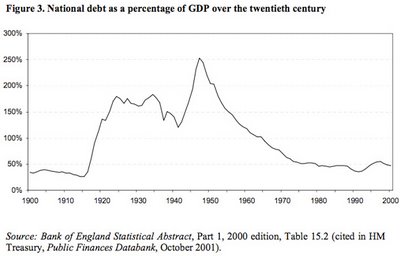
Debt will, of course, have to come down. But it is worth reflecting for a moment whether the increased debt in recent years (from 31.5 per cent in 2002) was worth it. Richard Koo, who coined the phrase “balance-sheet recession” used recently by George Osborne, has explained that in scenarios where the private sector is seeking to minimise debt (as currently in the UK), the government has a responsibility to increase its balance sheet for example through public works programmes.
That is precisely what has happened in the UK since 2007. Debt stood at a relatively low level of 37.2 per cent by historical standards at the onset of the Great Recession. The spiralling deficit was due primarily to automatic stabilisers such as unemployment benefits doing their job and the emergency measures to stimulate the economy.
Without those measures, GDP would have plummeted by even more than it did. So even if you prefer Cecchetti’s debt figures to the ONS’, 0.1 per cent a year off growth looks like a price worth paying for avoiding a depression.
To reach hundreds of thousands of new readers and to make the biggest impact we can in the next general election, we need to grow our donor base substantially.
That's why in 2024, we are seeking to generate 150 additional regular donors to support Left Foot Forward's work.
We still need another 124 people to donate to hit the target. You can help. Donate today.
18 Responses to “Sun and Mail debt scare story obscures the truth”
Political Planet
Sun and Mail debt scare story obscures the truth: Will Straw looks at today’s Sun and Mail scare stories about d… http://t.co/ay5lMsM
Pete Jefferys
Where would we be without @wdjstraw graphs on LFF? Another demolition job on the right, worth a read: http://t.co/gUAcbzd
Kevin Arscott
Sun and Mail debt scare story obscures the truth: http://t.co/VK3kp0J writes @wdjstraw
Psyc_social
RT @leftfootfwd: Sun and Mail debt scare story obscures the truth: http://t.co/yfGSj6U writes @wdjstraw
Michael Bater
RT @leftfootfwd: Sun and Mail debt scare story obscures the truth http://t.co/MKkkQIQ